
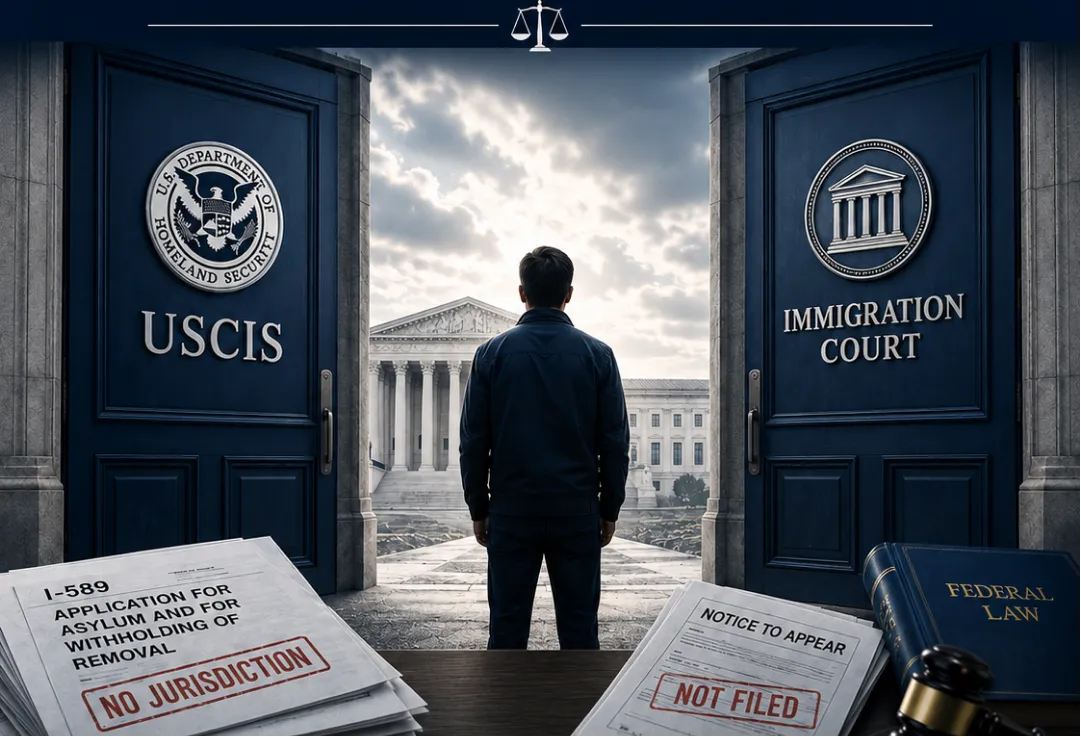
Escaping the Asylum Jurisdictional Gap: Using Mandamus to Break the Bureaucratic Deadlock
For asylum seekers who entered the United States without inspection (EWI), the path to legal protection often dead-ends in a "bureaucratic void." You may have filed your asylum application with U.S. Citizenship and Immigration Services (USCIS) only to be told they lack jurisdiction, while the Immigration Court (EOIR) simultaneously claims it has no record of your case.
This jurisdictional gap leaves applicants in a state of indefinite limbo, trapped without work authorization, travel permission, or a forum to hear their claims. At Immigrant Lawyer, we have spent 7 years navigating the most complex corridors of immigration litigation. When the government refuses to perform its mandatory duties, we use federal mandamus lawsuits to force a resolution.
Understanding the Jurisdictional Gap
The divide in asylum jurisdiction is governed by specific legal triggers. To navigate this, you must understand the distinction between a document being "served" and being "filed."
USCIS Jurisdiction: Under 8 CFR § 208.2(a), USCIS has initial jurisdiction over asylum applications from individuals not in removal proceedings.
Immigration Court Jurisdiction: Per 8 CFR § 1003.14(a), jurisdiction vests with the Immigration Court when a charging document, the Notice to Appear (NTA), is filed with the court clerk.
The Deadlock: For years, USCIS used the "Lafferty Memo" to reject jurisdiction over anyone who had been served an NTA, even if DHS never filed it with a court. While an October 2023 policy update allowed some EWI applicants to file by mail, thousands remain trapped because neither agency will acknowledge its authority to act.
Three Common Scenarios of Asylum Limbo
1. NTA Served But Never Filed
DHS serves you an NTA but fails to submit it to the court. USCIS rejects your I-589 because you are "in proceedings," but the court has no record of you. This scenario often causes applicants to miss the critical one-year filing deadline. Under the Mendez-Rojas settlement framework, this jurisdictional confusion can be argued as an "extraordinary circumstance" to excuse a late filing, but only if the applicant acts decisively.
2. Credible Fear Passed, Then Released
After passing a credible fear interview and being released, you wait for a court date that never arrives because the NTA was never filed. You have a confirmed fear of persecution, yet you are barred from both the affirmative and defensive systems alike.
3. Affirmative Filing After EWI
If you were never apprehended and you file affirmatively, USCIS may still refuse to adjudicate based on the manner of your entry, despite the absence of any pending removal proceedings. This is a direct violation of 8 CFR § 208.2(a).
The Solution: Federal Mandamus and APA Litigation
When agencies refuse to adjudicate, federal courts provide the only remedy under the Mandamus Act (28 U.S.C. § 1361) and the Administrative Procedure Act (APA). Our strategy relies on the "no alternative remedy" argument: because no other agency claims jurisdiction, the court must intervene to prevent a total denial of due process.
What Courts Can Compel | What Courts Generally Cannot Compel |
Adjudication of a pending I-589 application | The specific outcome (grant or deny) of the case |
Establishment of a reasonable decision timeline | The initiation of removal proceedings/NTA filing |
A declaration that the delay is "unreasonable" | The exercise of prosecutorial discretion |
USCIS to accept jurisdiction per regulations | Dictating which specific court hears the case |
FOIA Production: Delivery of your A-File | FOIA Exemptions: Overturning valid law enforcement secrets (Libarov, 2025) |
The Critical Role of FOIA and the 2025 Whistleblower Scandal
Obtaining your A-File is the first step in building a litigation record. However, the system is currently facing an integrity crisis.
·Statutory Deadlines: Agencies have 20 business days to respond. If they fail, we can file a FOIA lawsuit.
·Manufactured Closures: A 2025 whistleblower disclosure revealed that USCIS leadership at the National Records Center directed staff to "manufacture" FOIA rejections to subvert the Nightingale v. USCIS injunction. Rejections for "inaccurate information" jumped from 5,427 in 2024 to 41,918 in 2025.
·The Tactic: USCIS has been closing cases for minor, optional discrepancies, such as inverting birth dates (day/month) or using an attorney’s address instead of a personal one, even when A-Numbers match perfectly. We use FOIA litigation to bypass these bad-faith administrative hurdles.
The Litigation Process and Practical Realities
Federal litigation is a serious undertaking. Here is what to expect:
Administrative Exhaustion: We aggressively build a record of exhaustion through service requests, Ombudsman complaints, and formal demand letters.
Filing and Costs: A federal complaint is filed (typically a 405 filing fee**). Attorney fees for these complex suits generally range from **4,000 to $6,000.
Serving the Government: We serve the U.S. Attorney, the Attorney General, and Agency Heads.
Response Timelines: For standard Mandamus/APA claims, the government has 60 days to respond. However, for FOIA-specific lawsuits, the government must answer within 30 days under 5 U.S.C. § 552(a)(4)(C).
EAJA Fee Recovery: While the Equal Access to Justice Act (EAJA) allows for fee recovery, it is rare in these cases. If USCIS "moots" the case by scheduling an interview after we file, courts often decline to award fees.
Risks and Recent Developments
Mandamus is a tool to compel a decision, not a guarantee of an approval.
·Potential Outcomes: Adjudication can result in Approval, Referral to Immigration Court (ending the limbo by creating a forum), or Dismissal under 8 CFR § 208.14(c)(1). Dismissal is a risk if DHS determines charging documents are not issuable; we prepare every client for this possibility.
·The 2025 Asylum Freeze: Policy Memorandum PM-602-0192 (December 2025) has placed holds on many adjudications. However, we are successfully using Mandamus as a "carve-out" mechanism, arguing that a policy memorandum cannot override the statutory duty to conclude matters within a reasonable time.
·Workforce Reductions: The Department of Government Efficiency (DOGE) and 2025 federal workforce reductions have decimated FOIA and asylum support contracts. These systemic failures make judicial oversight more critical than ever.
Every immigration case is unique; results depend on specific facts and the jurisdiction in which the case is filed.
If your life is on hold because of a jurisdictional deadlock, you cannot afford to wait for a system that is designed to ignore you. Immigrant Lawyer has spent 7 years forcing the government to follow its own rules. Contact us today for a professional evaluation to see if a federal mandamus lawsuit is the right strategy to break your case out of the bureaucratic void.
Standard Disclaimer: This article is for general informational purposes only and does not constitute legal advice. For an evaluation based on the specific facts of your case, you may contact us.